The Royal Academy of Arts exhibition Peggy Guggenheim in London: The Making of a Collector runs at Burlington House from 21 November 2026 to 14 March 2027. Its subject is unusually concentrated: the eighteen months in 1938 and 1939 when Peggy Guggenheim ran Guggenheim Jeune on nearby Cork Street. That short interval makes the show more than a biographical survey. It offers a way to watch a collector learning through exhibitions, friendships and the friction between international modernism and a cautious London art establishment.
For a visitor, the most useful approach is selective. Follow how the gallery moved between abstraction, Surrealism and British modernism; then use the archival material to test how Guggenheim's programme and network worked in practice. The London period did not single-handedly create her later collection, but it gave her an early public arena in which to refine judgment and build relationships.
Before Venice: the Cork Street experiment
The Peggy Guggenheim Collection's exhibition history dates Guggenheim Jeune from January 1938 to June 1939 and records more than twenty exhibitions. The programme included Kandinsky's first solo show in London, a Jean Cocteau exhibition, a group exhibition devoted to collage and a contemporary sculpture show. It was broad enough to put local artists beside European abstraction and Surrealism without smoothing away the differences between them.
The Art Newspaper's account of Guggenheim Jeune independently confirms that the gallery opened in January 1938 and closed eighteen months later. It also gives the useful corrective to a romantic origin story: the enterprise lost money, and Guggenheim closed it while considering a museum of modern art in London with Herbert Read. War intervened. The point for today's visitor is less that Cork Street predetermined Venice than that it was a testing ground for the artists, advisers and exhibition formats that informed what followed.
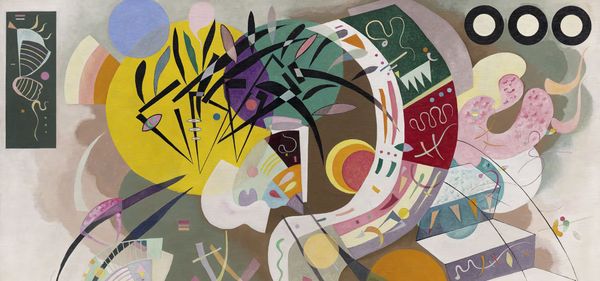
Start with Vasily Kandinsky's Dominant Curve, painted in April 1936 and confirmed by the Royal Academy as part of the exhibition. It connects the display to Guggenheim Jeune's early commitment to abstraction and to Kandinsky's London solo show. Rather than treating the painting as a trophy name, look at the confidence required to place this visual language before a late-1930s London audience.
Then find Yves Tanguy's The Sun in its Jewel Case. The Royal Academy identifies it as an exhibited work, while the wider programme places Tanguy among the gallery's Surrealist strand. Its presence makes the range of Guggenheim's London experiment tangible: she was not assembling one coherent school so much as learning how distinct avant-garde positions could coexist under a single programme.
Paul Nash's Nocturnal Landscape completes the route. The Royal Academy also confirms it for the exhibition. Set beside Kandinsky and Tanguy, Nash brings the viewing exercise back to Britain and prevents the story from becoming one of continental modernism simply arriving in London. Together, the three works give the visitor a compact way to read the gallery's range without turning the exhibition into a roll call of famous names.
What to notice in the Royal Academy galleries
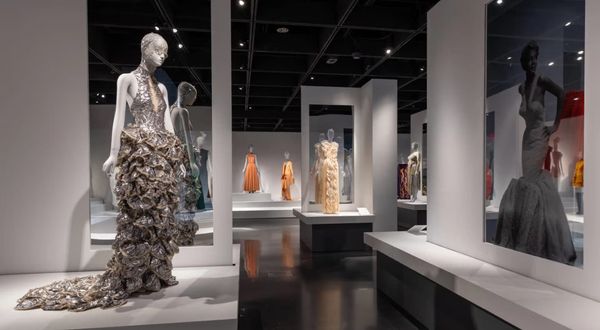
The exhibition combines artworks with archival material, according to the official Peggy Guggenheim Collection overview. Give the documents as much attention as the paintings. They can show how exhibitions were assembled, how advice circulated and how a commercial gallery became an intellectual meeting point. That evidence is where the idea of a "collector in formation" becomes specific rather than celebratory.
Do not look for a simple before-and-after conversion. A more revealing question is how each choice widened Guggenheim's field of reference. Kandinsky represents one kind of international abstraction; Tanguy another Surrealist language; Nash a British response to landscape and modernity. The archive should help connect those works to the gallery's programme while leaving room for later experiences, especially in Paris and New York, to reshape her collection.
Before you go
The exhibition is at the Royal Academy of Arts, Burlington House, Piccadilly, London W1J 0BD. The public run is 21 November 2026 to 14 March 2027; Friends' previews on 18-20 November are separate from the public opening. Art Fund's current visitor listing confirms the address, dates, public access and accessible facilities.
Time Out's listing checked on 13 November 2026 gives admission as £17. Treat that as a current listing, not a guaranteed final price: check the Royal Academy's official exhibition and booking page for the live price, concessions and availability before travelling.