Inside Van Cleef & Arpels' Mystery Set: What to Notice in Lyon
Running in Lyon from 21 to 28 November 2026, de Mains en mains pairs finished jewels with live craft demonstrations. Here is how to look closely, and what to confirm before reserving a visit.
The real appeal is visual literacy. High jewellery is usually encountered after every working trace has been resolved into line, colour, movement and polish. Here, the route back through the process can sharpen the way you read the completed object. Look beyond the scale of a stone. Notice whether a curve holds its rhythm, whether a surface changes cleanly with the light, and how little metal interrupts the colour.
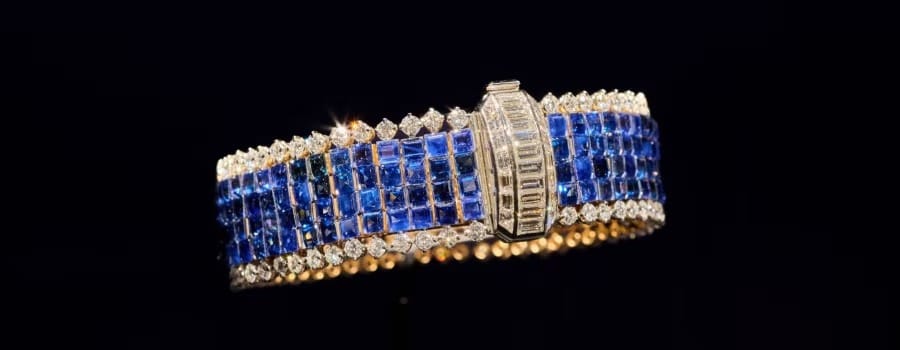
Mystery Set: what to notice when the metal recedes
Mystery Set can appear, at first, as a field of uninterrupted colour. The engineering becomes easier to appreciate at the edges and around changes in volume. The Maison's official Mystery Set archive records that the technique was patented in 1933 and describes individually cut stones aligned on gold rails so that the set surface is covered. An independent account in Le Monde likewise explains the effect as stones mounted on rails that are invisible from the finished face.
That distinction matters: the metal has not vanished; it has been designed out of the first impression. During the demonstration, follow the continuity of colour across the surface, then inspect the contour where the pattern has to turn. On a finished jewel, ask whether your eye sees the image before it sees the setting. That is a more useful close-looking test than simply counting stones.
The official pathway lists six working areas: gouache painter, 3D designer, polisher, stone expert, jeweller and gem-setter. Lyon's tourism office programme independently describes the demonstrations and the same core roles. Read them as a viewing sequence rather than a catalogue of professions.
A gouache establishes the intended relationship between line and colour. Three-dimensional conception tests how that drawing behaves as volume. The jeweller gives the piece its structure; the gem-setter negotiates the meeting of stone and metal; polishing determines how the final surface receives light. The stone expert's choices affect the continuity of colour that becomes especially visible in Mystery Set work. The programme does not suggest that every jewel follows a single, public assembly order, but the route gives the eye six useful questions to carry back to the display case.
Do not assume that a jewel mentioned in earlier coverage will be present in Lyon. Nor should a replica, drawing or model be mistaken for the finished original. The useful question is simpler: which decision made at the bench can you still read in the completed object?
At the display, make one pass for the face of the jewel and another for its edge, articulation and reverse. The second look is often where a polished object begins to reveal the hands behind it.