Cartier's Into the Wild is open at Villa Haw Par in Hong Kong from 31 October to 8 November 2026. The official event page lists the public dates, while a South China Morning Post account of the presentation places it at Villa Haw Par and reports five rooms devoted to Panthère creations, history and interactive material.
The useful way through is selective. Look past the inventory of precious materials and ask three questions of each finished jewel: does its silhouette suggest a body in motion, does its surface describe skin or fur, and does it behave convincingly when worn?
Why Villa Haw Par changes the view
The house is part of the argument. According to the Hong Kong government's heritage record, Aw Boon Haw built the mansion in 1935 in a Chinese Renaissance style, combining a broadly Western plan with Chinese and Western construction ideas. Porches and bay windows sit alongside Italian painted glass, gilded carving and murals with Indian and Burmese influences.
That mix makes a sharper backdrop. Against patterned glass and layered interiors, an animal jewel has to hold its outline as well as its sparkle. The villa's Tiger Balm history and feline-themed décor visible in current SCMP exhibition coverage create a setting charged with animal symbolism. Against it, visitors can compare imagery in the presentation with an object made to follow a body.
How the Panthère learned to move
Start with the difference between pattern and creature. Cartier's archive account of the Panthère dates the first spotted motif on a watch to 1914 and the first full three-dimensional body to a 1948 gold-and-enamel brooch commissioned for the Duchess of Windsor.
The change becomes more tangible in the National Gallery of Victoria's authoritative Cartier labels. The Panther-pattern wristwatch, Cartier Paris, 1914, conveys the animal through irregular onyx spots within diamond pavé. The Panther clip brooch, Cartier Paris, 1949, gives it jointed legs and a neck that let the limbs ripple as the wearer moves. These are historical reference points, not a claim that both objects are on loan in Hong Kong. The lesson is visual: a pattern sits on a surface; a modelled cat needs weight, posture and a plausible relationship with the body.
Craft that creates character
On the Panthère de Cartier necklace and bracelet, look closely at the metal around the stones. Cartier's technical account of fur setting says grains of metal are folded into tiny threads around the stones to evoke a coat. It specifies that diamond diameters change with the modelled musculature, while hand-cut onyx or sapphire spots are larger on the back, smaller on the flanks and absent on the white belly. Vogue Singapore's independent report from the travelling installation also observed the technique in the craft display and described its raised, almost spiky effect on gold. The consequence is visual rather than statistical: the surface does not flatten the animal's anatomy.
A visual primer, not a room-by-room checklist
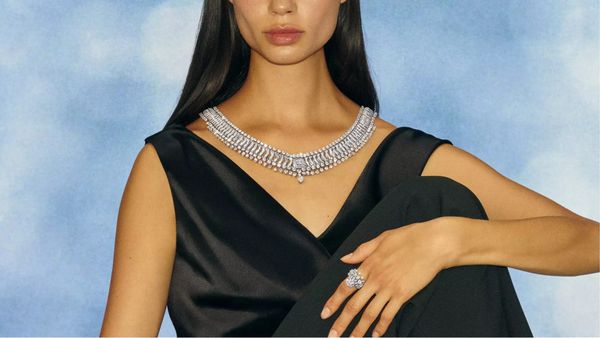
First, use the historical material to fix the move from graphic marking to anatomy. For contemporary comparisons, press imagery is a visual primer rather than a verified list of what is installed in Hong Kong. The SCMP report on Cartier's current fauna group shows a white-gold Panthère de Cartier necklace and bracelet, but the report does not establish that every pictured jewel appears in the exhibition rooms. Read the head and paws before the pavé. A convincing cat should have a discernible posture at arm's length; the close view then reveals how setting and differently scaled spots support it.
The independent report on the five animal-head designs identifies a tiger, parrot, carp, crocodile and rhinoceros. Whether encountered in the rooms or followed through the accompanying imagery, compare what has been edited: the angle of a beak, the mass of a rhinoceros, the direction of stripes. Small changes in silhouette do more to establish character than a longer list of materials.
Before you go
Into the Wild is at Villa Haw Par in Hong Kong through Sunday, 8 November. The current Culture Plus event listing describes admission as free but requiring advance online registration. As of 2 November, the official booking page reports full capacity and asks visitors to check back because additional appointments may become available. If you do not hold a slot, do not assume walk-in admission. No verified public opening hours or walk-in policy were available at filing.
Whether seen in person or followed through the documented objects, the exhibition's strongest idea is simple: an animal jewel becomes persuasive when surface, structure and wearability point in the same direction.