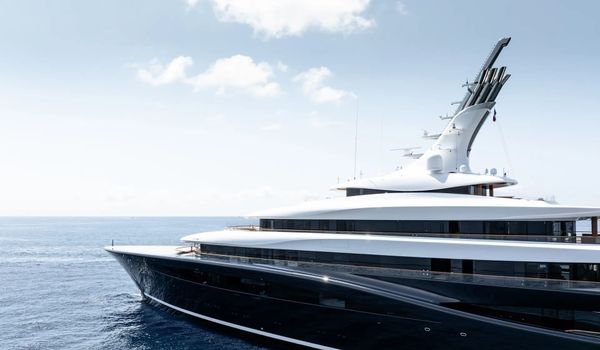
Feadship's 118.8-metre Breakthrough was named Yacht of the Year and Best in Motor 3000+ GT at the International Superyacht Society's Design & Leadership Awards in Fort Lauderdale on 28 October 2026. Feadship's results announcement records both titles, while an independent account of the completed ISS awards confirms them. The date belongs to the prizes, not the yacht: Feadship's July 2025 delivery announcement states that Breakthrough had been delivered earlier that year.
The result is a timely reason to look beyond the trophy. The more useful question for an owner or guest is how the yacht's sea-facing architecture and alternative energy system affect time on board, and where their claims stop.
A yacht that opens at the waterline
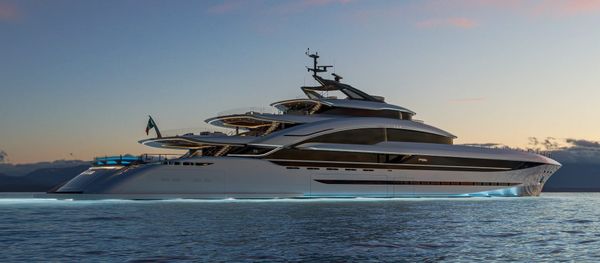
RWD designed both exterior and interior, with naval architecture by Feadship De Voogt Naval Architects. Instead of making length the main event, the design uses the hull as a series of thresholds. Feadship's current fleet record documents 14 deployable balconies and seven large opening platforms. Beneath the beach club, an underwater lounge has six near-floor-to-ceiling windows; the same lower-deck sequence includes a spa, steam room, sauna with plunge pools and a 12-seat cinema. An independent account of the guest spaces records the balconies, opening platforms, underwater lounge and wellness areas.
For guests, that arrangement creates different degrees of contact with the sea without turning every shared space into an exposed deck. A balcony can extend an interior room, while the lower deck moves between water-level views, wellness and film. The point is circulation and choice rather than the number of amenities.
What the hydrogen system is documented to do
According to Feadship's fuel-cell specifications, the yacht carries sixteen PowerCell fuel-cell systems with a builder-declared combined output of 3 megawatts. When supplied with hydrogen, they generate electricity without combustion on board, with water vapour at the point of use. Feadship says the system can cover the yacht's hotel load for up to a week at anchor, or support propulsion at 10 knots when leaving harbour or moving through protected marine zones.
Megayacht News's independent fuel-cell report records the same 16-unit architecture and operating modes, while attributing the endurance figures to Feadship. The practical guest benefit is tightly defined: hotel services can run without the conventional generators during that stated window, reducing combustion, noise and vibration on board at anchor. It is not a claim about every voyage.
Where the environmental claim stops
Feadship's propulsion and generator specifications show that Breakthrough also carries conventional MTU generators, ABB azimuthing pod drives and substantial liquid-fuel capacity. A specialist account of the conventional-energy architecture reports that the liquid-hydrogen storage is not sufficient for an ocean crossing and that MTU generator sets remain part of the system for longer passages.
The distinction matters. Hydrogen operation can remove onboard combustion from specified hotel-load and low-speed modes, but the reviewed evidence does not establish that every function, itinerary or the yacht's full lifecycle is emission-free. Nor does the award settle that question: the ISS judging process is a peer review by twelve industry professionals, not an independent sustainability certification.
For a prospective owner or charter client, the relevant achievement is the pairing of RWD's water-facing spaces with the option of quieter, combustion-free operation in clearly bounded modes. The award makes that combination worth examining; it does not remove the need to ask which energy source is in use for a particular passage.