The Watches of Tomorrow

– 4 min read


Hublot has proved once again that it can still rewrite the rules of the game. This September, at its Geneva boutique, the brand unveiled two new creations developed in collaboration with Jeff Koons.
Hublot celebrated the 20th anniversary of the Big Bang collection in 2025. The milestone inevitably prompted a look back at the watch that changed the brand's fortunes—a launch I remember vividly.
At BaselWorld 2005, few visitors even stopped at the Hublot booth near the entrance without giving it a second glance. They were convinced the brand had nothing left to surprise the industry with and that its place at the fair would soon be taken by someone else. Then came the news that Jean-Claude Biver, who had recently left Swatch Group, had acquired the company. Almost out of thin air, he created the Big Bang concept—an audacious watch with an equally provocative name that would go on to become one of the most recognizable timepieces in the world.
Since then, Hublot's design language has, in many ways, remained frozen in time. The manufacture introduced the MP (Masterpiece) collection of highly complicated three-dimensional watches, partnered with Ferrari, launched the square-shaped Square Bang and the Classic Fusion line as a tribute to the brand's earliest models. Yet none of them managed to recreate the impact of the original Big Bang. It even seemed that the manufacture in Nyon had come to terms with that reality.
This spring's Big Bang Reloaded collection at Watches & Wonders felt almost like an acknowledgment: the idea may be twenty years old, but it can still be reinterpreted.
But can genuinely new ideas still emerge in an era when everyone seems afraid to take risks?
As it turns out, they can.
Working with a celebrated contemporary artist is nothing new for Hublot. Previous collaborations generally incorporated the artist's visual language into the brand's established aesthetic without touching its sacred cow—the architecture of the case itself.
Jeff Koons is a very different story.
His place in the art world remains deeply polarizing. Critics accuse him of pushing neo-pop to the point where irony and outright kitsch become almost indistinguishable, while others see his work as excessively commercial. In this case, however, those very qualities proved to be exactly what Hublot needed.
The first watch created by Koons still fits comfortably within the familiar framework of an artistic watch collaboration. The MP-14 Origin by Jeff Koons joins Hublot's Exceptional Timepieces collection—the brand's experimental laboratory dedicated to radical mechanical concepts, advanced materials and unconventional approaches to displaying time.
And when you're working inside an "experimental laboratory," almost anything becomes possible.
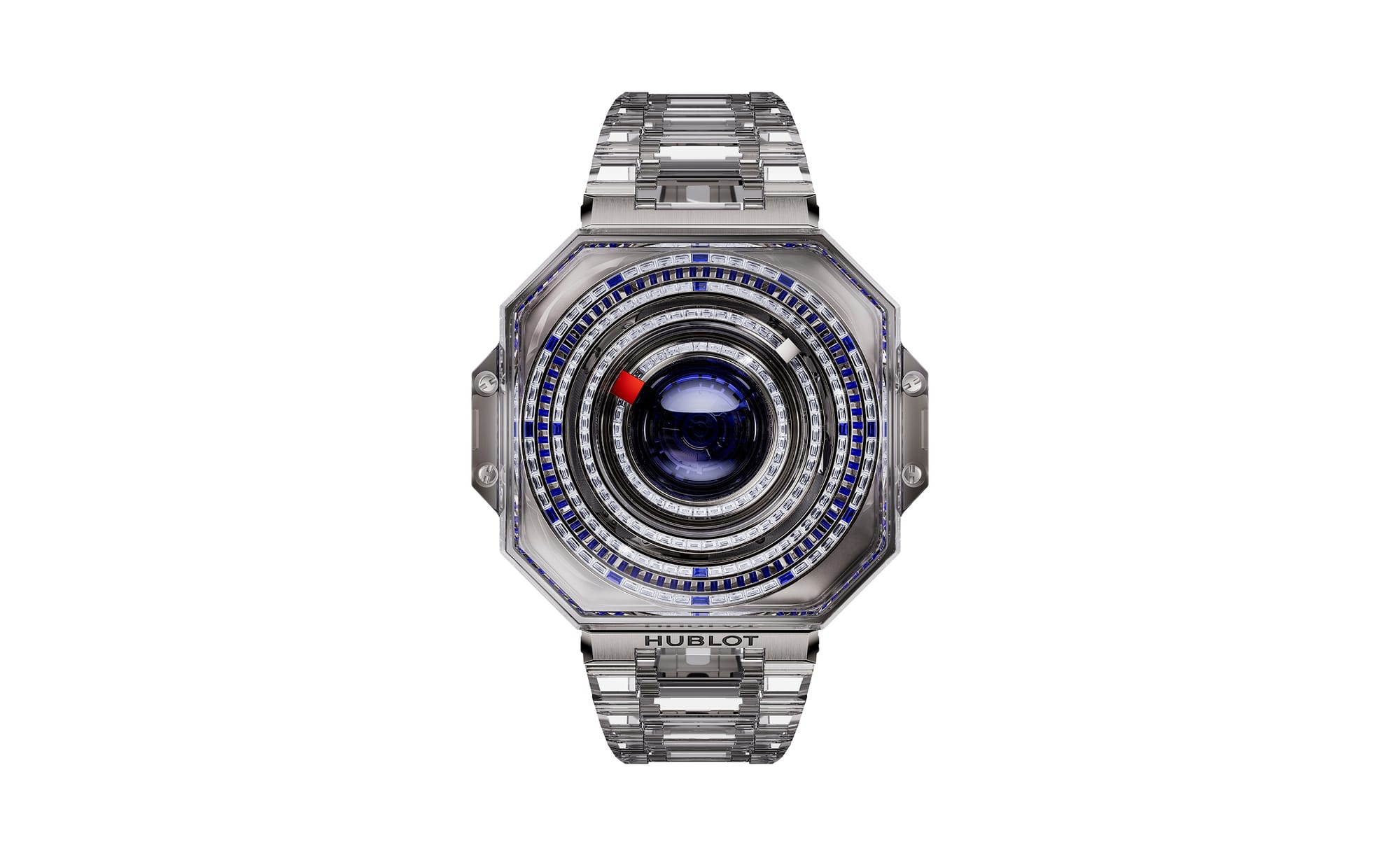
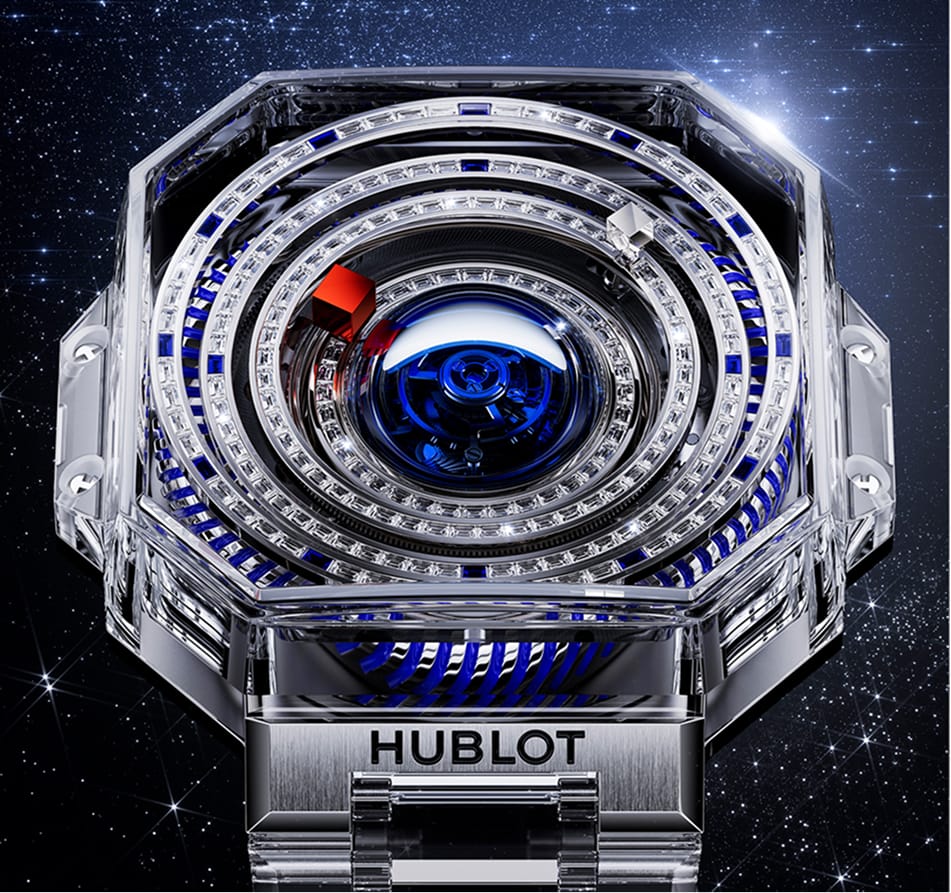
The 44 mm case takes the form of a transparent octagonal sapphire box. Inside, the watch unfolds like a miniature gravitational system. Concentric white-gold rings, set with baguette-cut diamonds and blue sapphires, create a series of orbital layers converging on a central core. Beneath a transparent sapphire dome inspired by Koons' iconic Gazing Ball sculptures and hand-coated with translucent blue varnish by a miniature painter, the hidden central tourbillon becomes the origin around which the entire universe revolves.
Hours and minutes are displayed by two suspended rotating rings carrying floating indicator cubes—a polished red stainless-steel cube coated with translucent red varnish for the hours and a polished grey stainless-steel cube for the minutes. Together they appear to orbit through space in a hypnotic celestial dance. Two additional rings remain fixed: the minute ring is marked by blue sapphires at the quarters, while the hour ring uses blue sapphires to indicate each hour. Altogether, the four rings are set with 202 gemstones totaling approximately 2.6 carats.
Driving this extraordinary construction is the manufacture HUB9014 movement: a central automatic tourbillon with a peripheral oscillating weight, beating at 3 Hz (21,600 vph), delivering a 60-hour power reserve, and comprising 594 components.
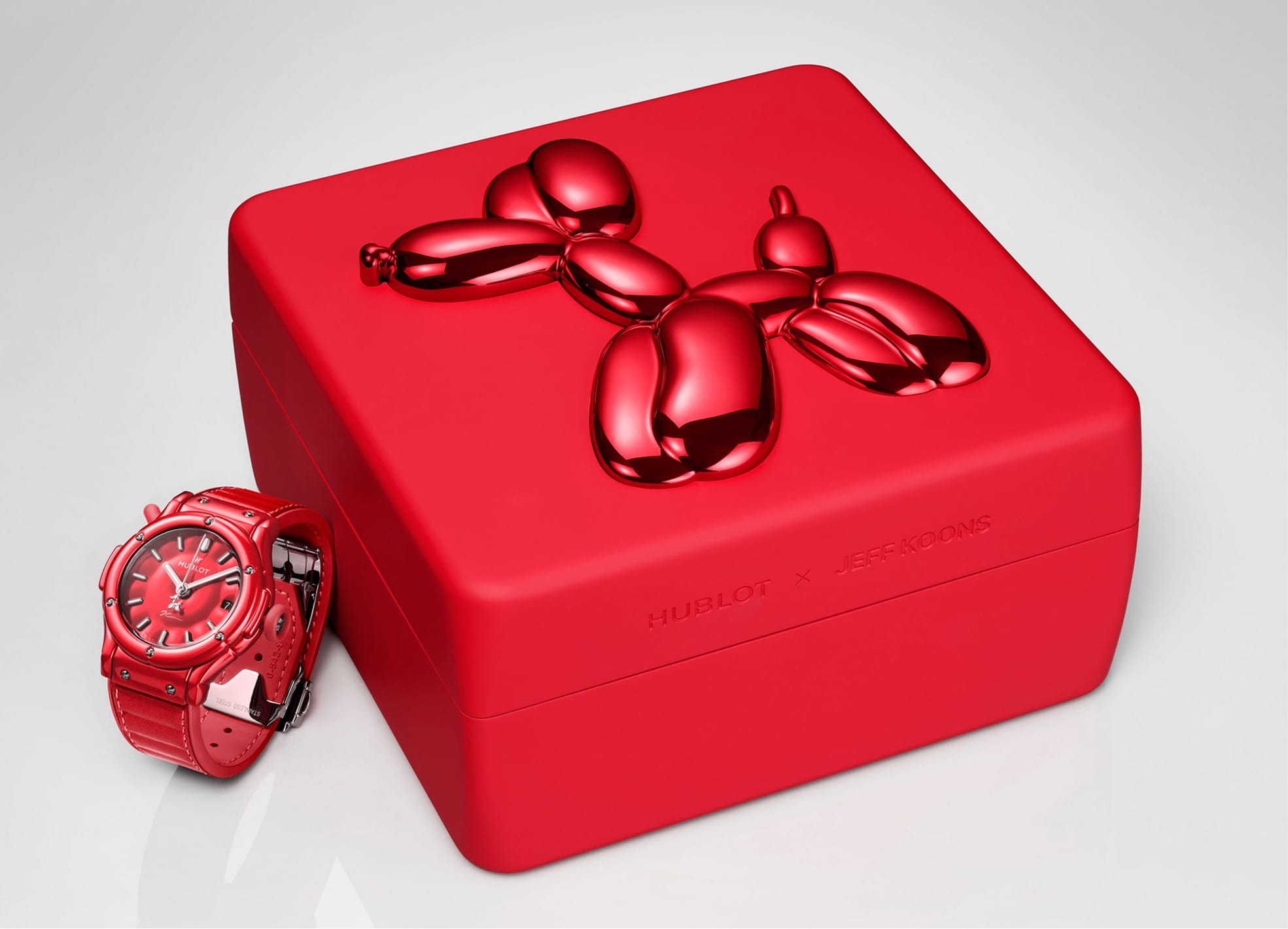
The watch is a true work of art, an impression reinforced by its octagonal presentation box, itself conceived as a mirrored LED installation. Production is limited to just 30 pieces.
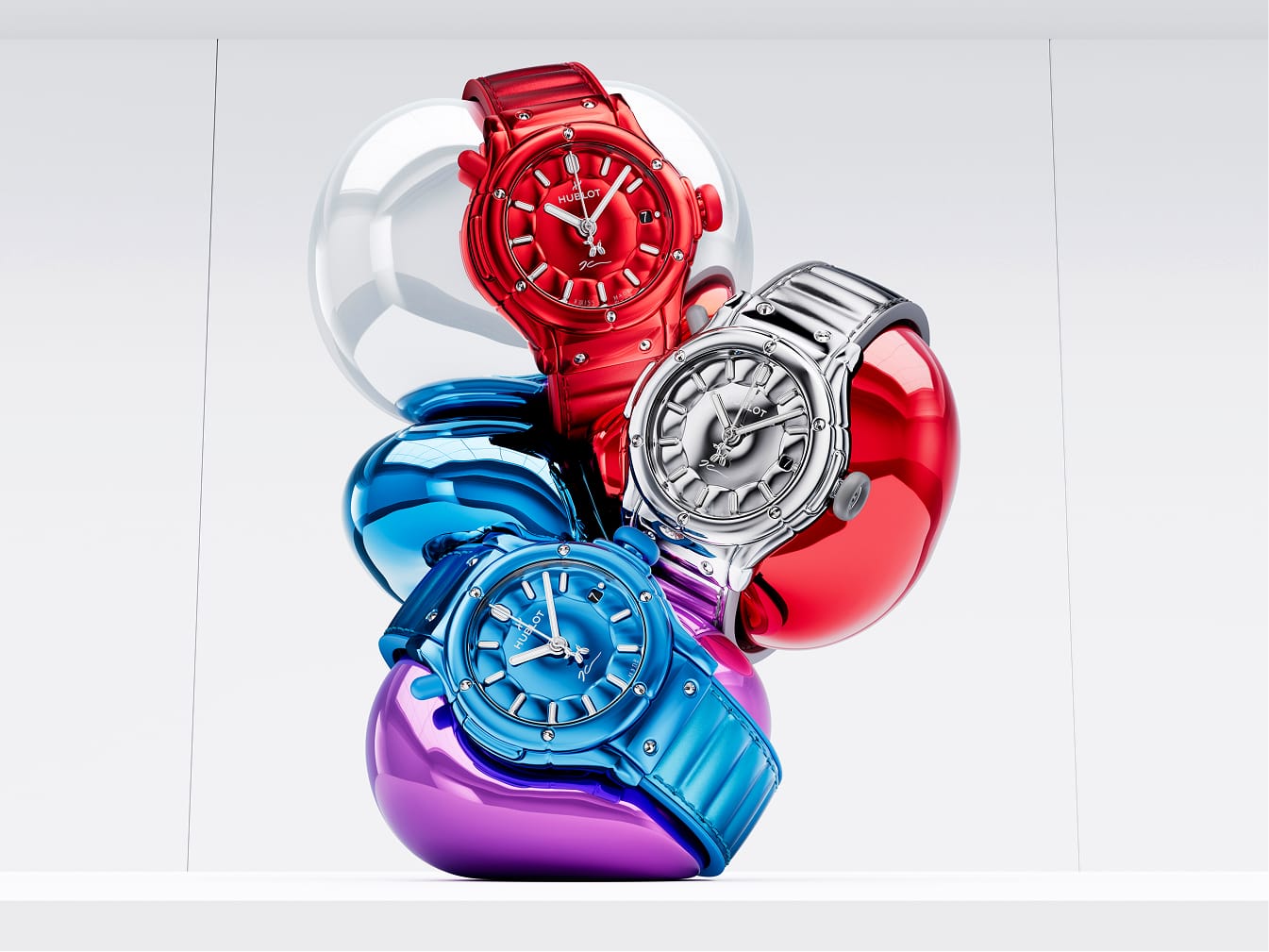
If the MP-14 is all about mechanical theatre, the Classic Fusion Balloon Dog is all about design.
There is little point in dwelling on the movement here: Hublot opted for the self-winding HUB1710, a straightforward time-only caliber.
Nor is this a story about gemstones—there aren't any.
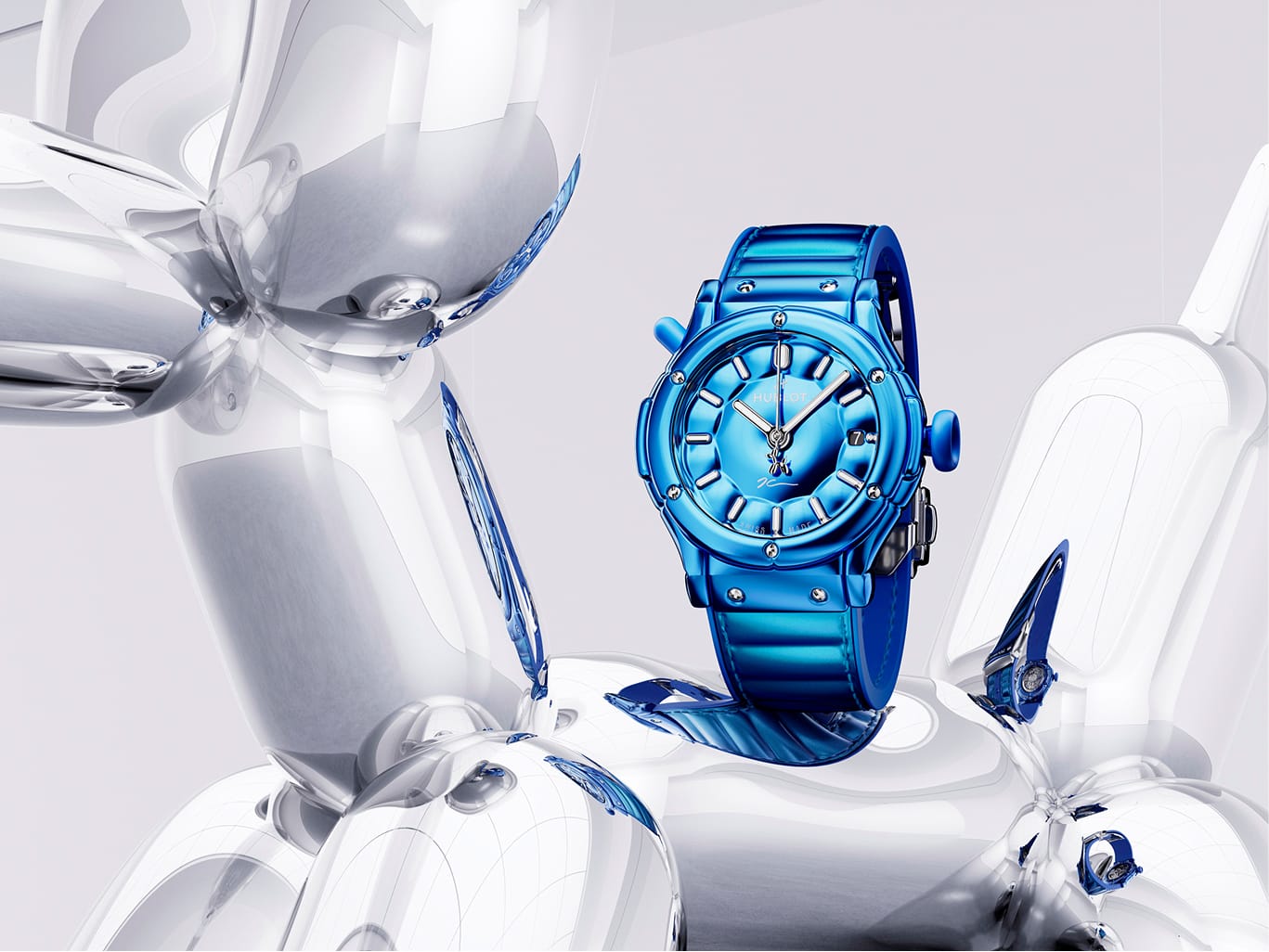
The case is crafted from polished anodized aluminum in either red or blue, while the silver version is executed in polished stainless steel.
What truly matters is the design. Inspired by Koons' iconic reflective Balloon Dog sculpture, it completely reimagines what a Hublot can look like.
Every element of the 42 mm Classic Fusion Balloon Dog has been reinterpreted through Jeff Koons' visual language. The traditionally restrained architecture of the Classic Fusion gives way to inflated forms, softly domed surfaces and flowing convex lines, creating the illusion that the watch itself has been shaped by air pressure. Even the crown, combining polished anodized aluminum with rubber, is styled to resemble the inflation valve of an actual balloon.
The result is playful, irreverent and, despite its apparent simplicity, remarkably sophisticated from both a technical and design perspective. Each version is limited to 200 pieces.
The color. The form. The texture. Hublot has never produced anything quite like it.
For that matter, neither has anyone else.