Kandima Maldives: the art of living at full volume
– 8 min read

There is a particular version of the Maldives that most people carry in their imagination long before they arrive: the overwater villa, the glassy lagoon, the careful, considerate silence of a place designed above all else to be undisturbed. That version exists, and it is not wrong. But it is not the only one. Kandima Maldives, spread across more than three kilometres of a private island in Dhaalu Atoll, operates on a fundamentally different premise. Here, the question is not how still you can become, but how fully you can live.
I have spent years writing about places that ask you to slow down, to disconnect, to let the hours dissolve. Kandima does something rather more interesting. It asks you to show up. The resort was conceived from the outset as a lifestyle destination, not a retreat, and that distinction shapes everything: the architecture, the pace, the noise level, the kind of laughter you hear at the pool bar at six in the evening. What the designers understood, and what takes about forty-eight hours to fully feel, is that a family travelling together needs a different kind of space than a couple on their first anniversary. That a twelve-year-old with boundless energy and a mother who has earned a long massage are equally legitimate guests. Kandima was built to accommodate all of them, at the same time, without compromise.
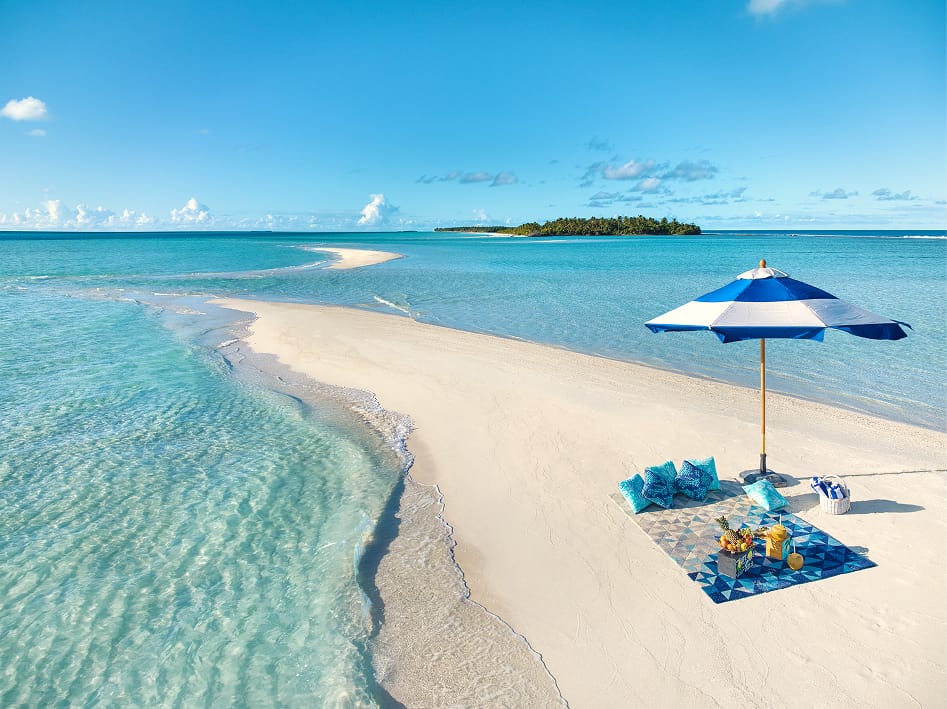
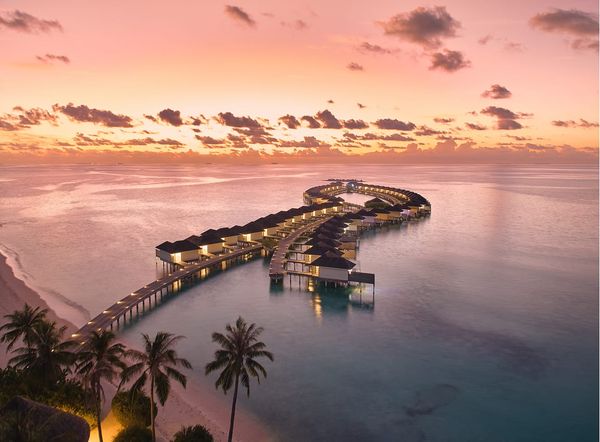
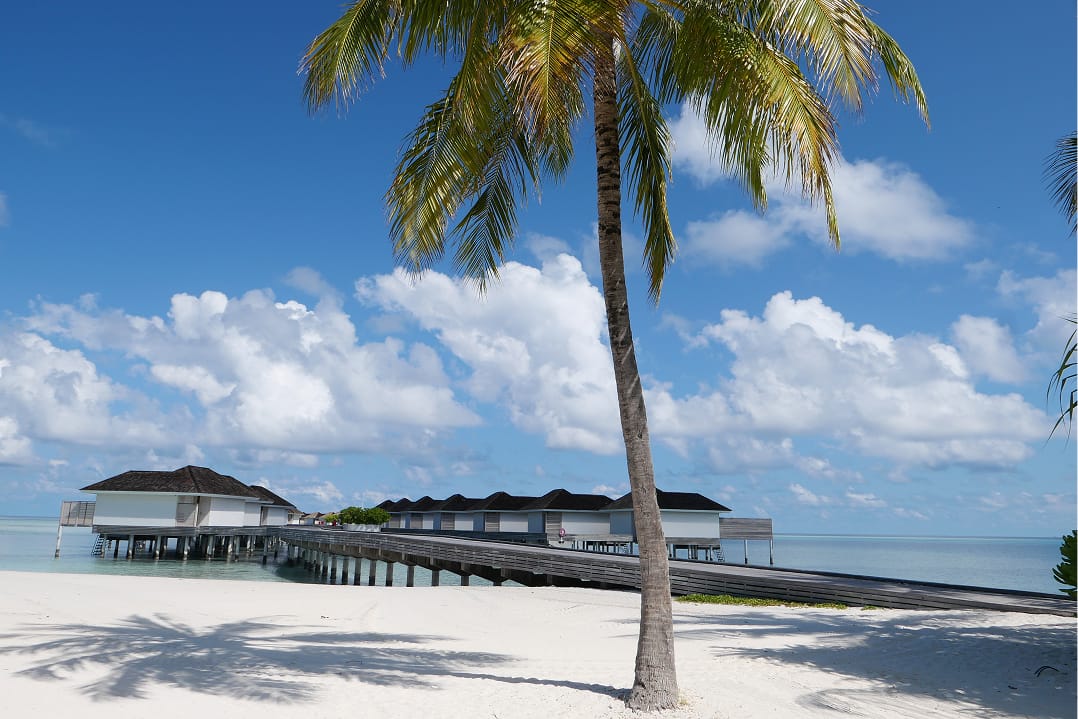
The physical scale of the island is the first thing that recalibrates expectations. At over three kilometres end to end, Kandima is not an island you circle in twenty minutes on a morning walk. It has its own internal geography: a forest path through the centre, shuttle buses that loop every few minutes, and a hire bicycle leaning against the door of your villa when you arrive, an invitation rather than an amenity. The 270 studios and villas are distributed across the island with enough distance between them that nothing feels compressed or overlooked. Water villas extend on a long curved jetty above the lagoon. Beachfront studios sit between the palms and the shore. The newer Coral Residences, with two and three bedroom configurations, are designed for those who travel not as a couple but as a household.
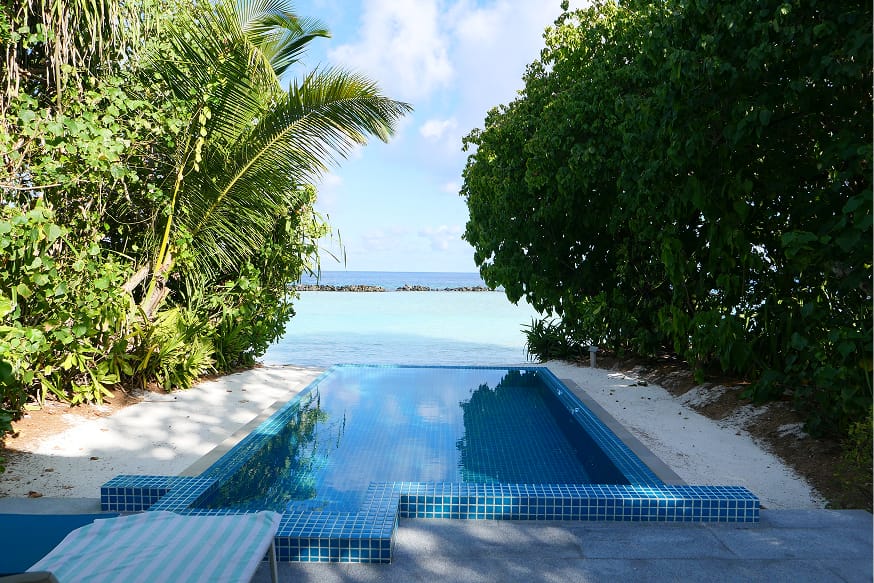
The Aqua Villas, positioned above the water on the main jetty, are the most visited accommodation on the island, and not only for the obvious reason of their lagoon views. The private swirl pool on the deck becomes, in practice, a kind of daily ritual chamber: iced drinks in the late afternoon, the water warm enough to stay in as the sun drops, the sky shifting through colours that resist accurate description. Below the deck, the reef is close enough for the shapes of reef sharks and manta rays to be visible without a mask. At dawn, before the island fully wakes, the stillness on that deck is complete.
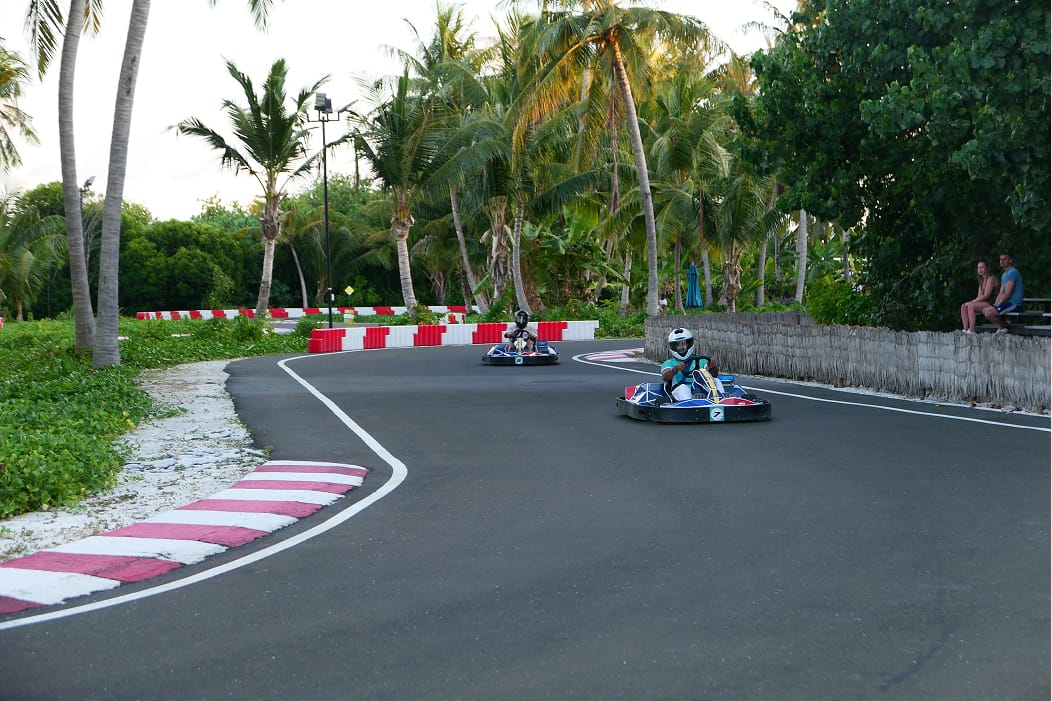
If there is one activity at Kandima that captures the resort's spirit most precisely, it is probably the go-karting. The Maldives is not a place one expects to find an asphalt track, and yet here it is: the only E-Go-Karting circuit in the archipelago, fast enough to be genuinely exciting, long enough to allow for actual racing lines. It is, on the surface, an absurd thing to do in the middle of the Indian Ocean. It is also, in practice, one of the most reliably joyful hours available on the island, for adults and children with equal intensity. The Maldives is built on the idea that its setting is sufficient. Kandima has added the idea that the setting is only the beginning.
The water-based programme is managed through the Aquaholics centre on the beach, and it covers the full range from the introductory to the genuinely accomplished. Snorkelling equipment is available to borrow for guests in the water villas, where the reef directly below the jetty rewards early morning visits. Certified divers can access the dive sites of Dhaalu Atoll, among the less-trafficked in the country. For those new to scuba, the open water certification is offered directly on site, in reefs where white-tip sharks move with the particular indifference of animals that have never been given reason for alarm. Sunset paddleboarding draws a different crowd: slower, quieter, the kind of activity that produces no photographs worth posting but a particular quality of tiredness at the end of the day that makes sleep arrive easily.
The dolphin cruises are among the experiences that guests mention first when asked what stayed with them. The boats travel into open water where pods of spinner dolphins are located by a crew that has been reading this ocean long enough to know where to look. The animals do not perform and are not encouraged to; they arrive on their own terms and leave when they choose. On a morning when the boat has fewer guests, the experience contracts into something almost private: the sound of the hull through the water, the sudden commotion at the bow as the first dolphins appear, and then, for a period that never quite matches what you expected in length, the spectacle of dozens of animals moving alongside the boat in the kind of unhurried synchrony that suggests they found us as interesting as we found them.
Kandima does not treat children as a logistical problem to be managed. PlaySpace, the resort's indoor entertainment hub, is the clearest expression of this: a bowling alley, arcade machines, karaoke facilities, escape rooms, a dancefloor, and a bar for the adults who inevitably follow their children inside and find themselves reluctant to leave. The space is designed with enough variety that different age groups occupy it differently, which is harder to achieve than it appears. The Kandiland programme adds structured activities at a gentler pace: craft sessions, nature-based activities, Valentine's card making that happens to be available year-round because the impulse to make something with your hands does not confine itself to a calendar.
The KULA Art Studio offers something that sits between activity and ritual. The 3D Hand Casting experience, in which couples or families create a permanent record of a moment in the form of an interlocked cast, is one of those ideas that sounds sentimental in description and feels, in practice, more quietly significant. The studio also runs one-to-one painting classes with a view over the resort's central lake, sessions that attract guests who would not ordinarily describe themselves as interested in art and leave carrying something they made with their own hands. There is a kind of intelligence in offering this alongside go-karting and dolphin cruises. It acknowledges that what people want from a holiday is not a single thing but a range of intensities, and that a day shaped by both effort and stillness is fuller than one composed entirely of either.
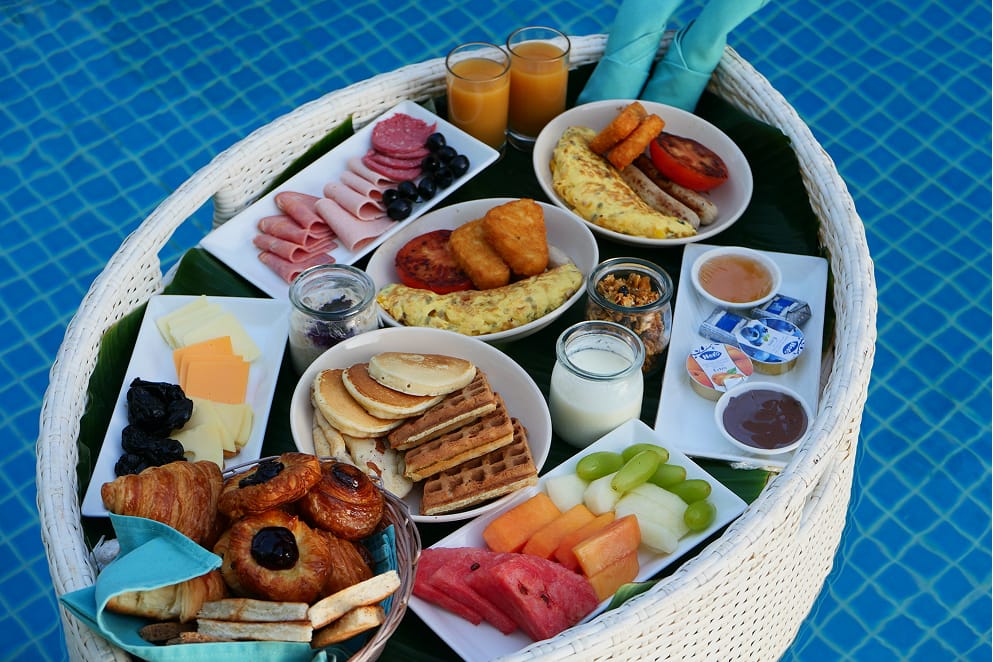
The ten food and beverage outlets at Kandima are distributed across the island in a way that makes the choice of where to eat feel genuinely consequential, which is a more difficult thing to engineer than most resort operators acknowledge. Zest, on the beach, is where mornings unfold: a buffet of considerable range and freshness, with live cooking stations and a position directly on the sand that makes it difficult to leave before ten. The à la carte restaurants each occupy a distinct register. Azure serves Mediterranean dishes at lunch and dinner, its position beside the beach and its Aperol Spritzes establishing it as the most reliably civilised two hours available on the island. Sea Dragon, built on decking above the water, serves seafood sourced locally and freshly, with views that make the proximity to the ocean something more than atmospheric backdrop. Smoked operates as a different proposition entirely: open fire, grilled meat and fish, the kind of menu that rewards the decision to eat outside.
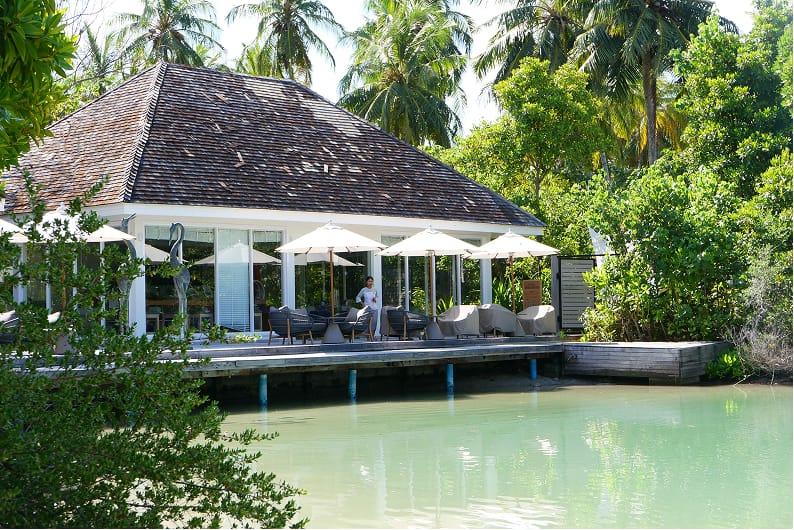
The presence of Aroma, a proper cafe serving coffee roasted by Meraki Coffee Roasters using Maldivian beans, is the kind of detail that registers most strongly after you've left. It signals that the resort understood the small domestic rituals of its guests: that the person who needs a real espresso at seven in the morning before the family wakes up is also one of the people it is trying to serve. The Meraki coffee also appears in the espresso martinis at Aroma and Deli, paired in the evenings with specialty desserts. The Breeze Bar beach club anchors the daytime social life of the island, with resident DJs later in the evening. The Forbidden Bar, by the PlaySpace building, runs a cocktail programme that includes a wasabi martini serious enough to warrant a second opinion.
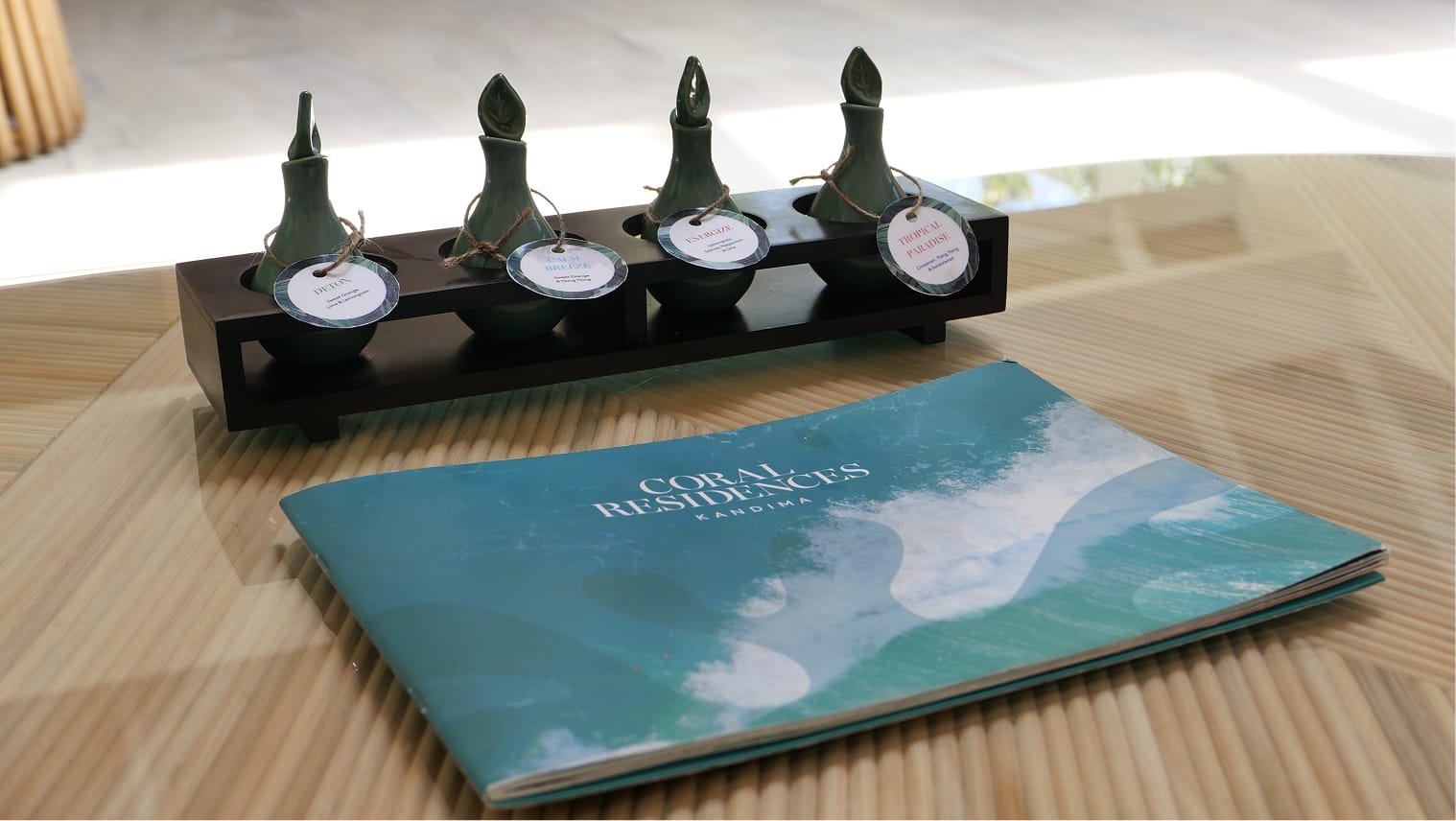
The esKape Spa holds its position at the quieter end of the island's emotional spectrum. Treatment rooms open directly onto the shore, so the sound of waves enters without invitation, which is an architectural decision that proves, in practice, more effective than any ambient soundtrack. The full treatment menu covers the expected range, from deep tissue massage to coconut body polish, but the facility earns its place most clearly in relation to everything around it: the spa is where the island's noise recedes, and where the particular tiredness produced by two days of go-karting, snorkelling and evening cocktails becomes something a trained therapist can read and address. The steam room and plunge pool extend the stay beyond the treatment table. After a session, the protocol is apparently to collect ginger tea and nuts on the terrace and watch the resident Flying Fox bats move between the palm canopy. I find this instruction easier to follow than most.
The Maldives has always been very good at offering one kind of perfection: the stripped-down, sky-and-water perfection of a place that has removed everything unnecessary. Kandima offers something harder to define and, in my experience, harder to find. It is the kind of resort where the twelve-year-old who came for the go-karting and the spinner dolphins leaves different from the one who arrived, not because something transformative was promised, but because three kilometres of island, a working reef, and ten restaurants were placed at her disposal with the quiet confidence that she would know how to use them. Her parents, meanwhile, had their massages and their Mediterranean lunch and their sunrise paddleboard and their evening at the bar. Nobody was managed. Everyone was accommodated.
There is a Maldivian saying that the ocean has no memory, only motion. Kandima seems to have taken this to heart. The water keeps moving, the dolphins arrive and depart, the karting track closes at dusk and the fire pits open, and the island cycles through its rhythms with the easy confidence of a place that has understood something important: that the best version of a holiday is not the one you expected to have, but the one that turns out to have had room for everyone you brought with you.