Nika Island: Forty Years of Coral, Craft and Continuity
– 6 min read

"A thing of beauty is a joy forever." — John Keats
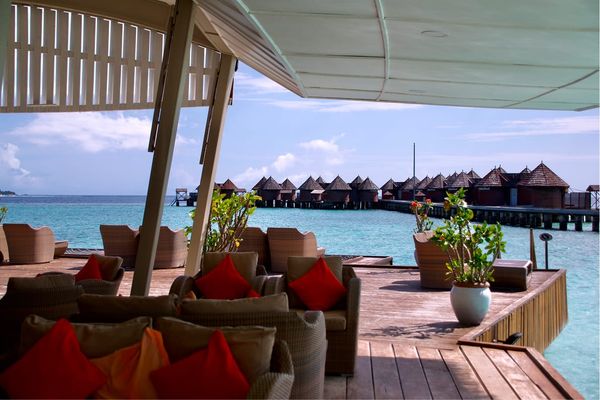
There are forty-four rooms on Nika Island, and every one of them is built from coral. Not coral-coloured render, not coral-inspired design, but actual coral blocks cut and laid by hand decades ago, when the Maldives was still a country of fishermen and the idea of a resort on a private island belonged to the realm of the improbable. The walls are thick, rounded at the edges, pale as bone. The roofs are thatched with palm leaves grown on the island itself. Standing inside my Deluxe Beach Villa on the first evening, running my hand along the rough, cool surface of the wall, I thought of the trulli of Alberobello in Puglia — those ancient conical stone houses that seem to have grown out of the earth rather than been placed upon it. Nika's villas carry the same quality: they do not sit on the island so much as belong to it, as though they had always been here and simply waited for someone to arrive.
The island's history predates tourism by centuries. It was a gift from a Sultan to his personal physician, a herbalist who crossed to the island each morning by boat to tend the plants he used in his remedies. Under his care, the bare sand became an agricultural island: coconut palms, tropical fruits, medicinal plants still part of Maldivian tradition. Families from neighbouring islands would come to gather the harvest. Before it was a resort, Nika was a garden.
The transformation came in the early 1970s, when Italian tourism entrepreneurs were beginning to look toward the Indian Ocean. An architect named Giovanni Borgo, connected to an Italian tour operator through the Maldivian Ministry of Tourism, conceived a plan that was radical for its time: sixteen villas, each with its own private beach, built from the island's own materials. The tour operator — the father of the woman who runs Nika today — expanded it, promoted it across Europe, and in 1983 opened the resort. The villas eventually grew to forty-four. But the principle has not changed. Nor have the walls. Today, when the use of coral in construction is no longer permitted in the Maldives, Nika's original coral-block structures stand as something that cannot be repeated.
Nika sits on Kudafolhudhoo Island in the North Ari Atoll, a seven-hectare island reached by a twenty-five-minute seaplane flight from Malé. The name "Nika" is Dhivehi for the banyan tree, and the island's central banyan is believed to be more than 350 years old. Its roots have spread so wide they form a kind of living architecture, a canopy beneath which the air drops several degrees and the light turns green.
This history is not hidden. In an underground museum — once the island's discotheque, later a spa — there are wooden tools, model boats, artefacts of the agricultural and seafaring past that preceded tourism. I spent a quiet half hour there one afternoon, and it did something that museums in hotels rarely do: it gave the place a timeline. It made clear that Nika is not a concept someone invented last year. It is a piece of living history, one of the first resort islands in the Maldives, and it wears that age not as a disadvantage but as a kind of authority.
The woman who runs Nika today — the founder's daughter, who has managed the island for fifteen years — calls it a longevity island. The term is not marketing. It is a reading of what the place naturally provides. The kitchen grows its own vegetables. The island composts everything. In 2022, Nika became the first resort in the Maldives to go entirely plastic-free. More than 110 coral frames have been planted around the island as part of a reef restoration programme. The blue zone principles — local food, daily movement, social connection, a relationship with nature — are not a programme here. They are simply the way the island has always operated.
"Longevity is not about supplements and vitamin bottles," she told me. "It is something you must live — in happiness, in nature, in connection with the sea."
She is also frank about what Nika is not. It is not fashion. It is not glass and infinity pools. "Nika is not for everyone," she says. "You either love it deeply or it is not for you. And that is fine."
I loved it. The feeling arrived not through any single grand gesture but through accumulation. The Marco Polo Restaurant — open, sandy-floored, with a wine cellar of more than a hundred varieties — rotates between Italian, Asian, and international menus each evening, so that by the fourth or fifth day you realise you have not eaten the same meal twice. The Italian chef prepared dishes that carried the ease and precision of a good trattoria. The cappuccino was correct, which in the middle of the Indian Ocean is not a small thing. Meals happened in the company of the same returning faces, guests and staff moving between tables with the comfortable familiarity of people who have been sharing a house for a few days.
On the western side of the island, a small coffee shop doubles as a library — more than six hundred books in several languages, a daily aperitivo at sunset, board games spread across low tables. I sat there most evenings with a glass of wine and a book, watching the sky do its work. It was the kind of place where time slows not because anything forces it to, but because nothing interrupts it.
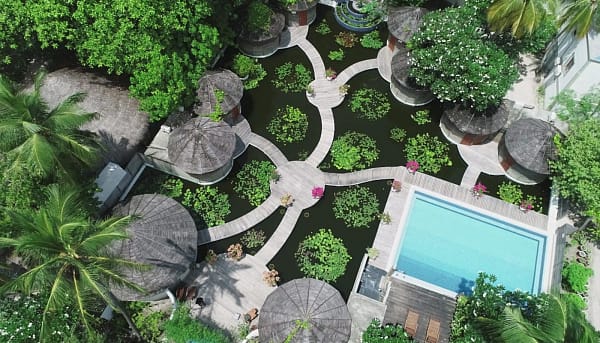
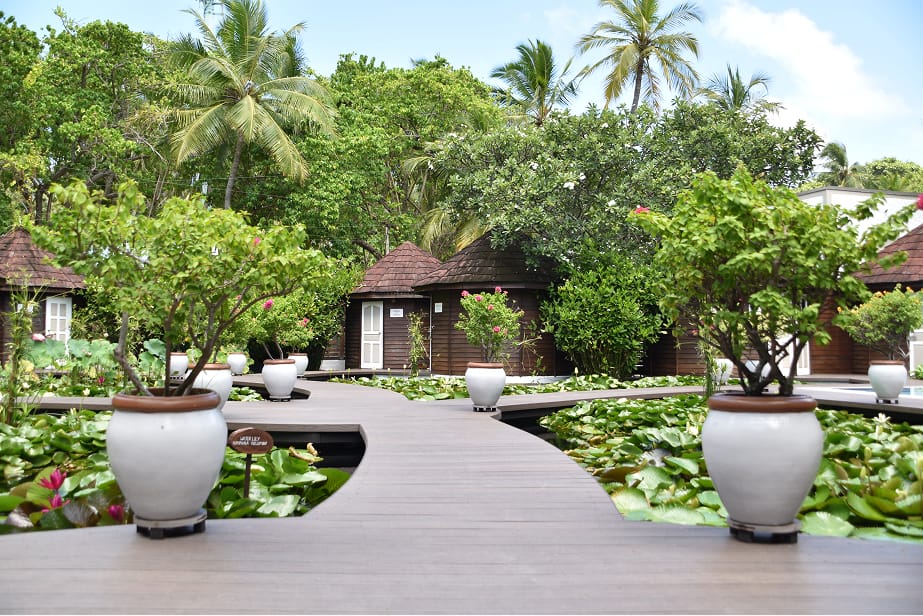
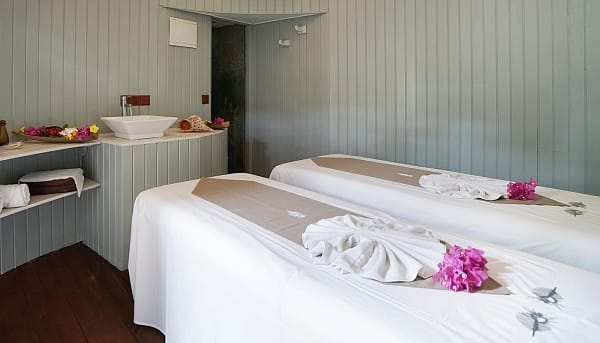
The Lotus Spa sits on an artificial lagoon, its eight treatment cottages named after landmarks in Venice — a quiet nod to the Italian-Maldivian thread that runs through the entire property. The therapies draw from Ayurvedic, Balinese, and Thai traditions. I had one treatment during my stay. It was good. But the real therapy, as is often the case in this part of the world, was the water.
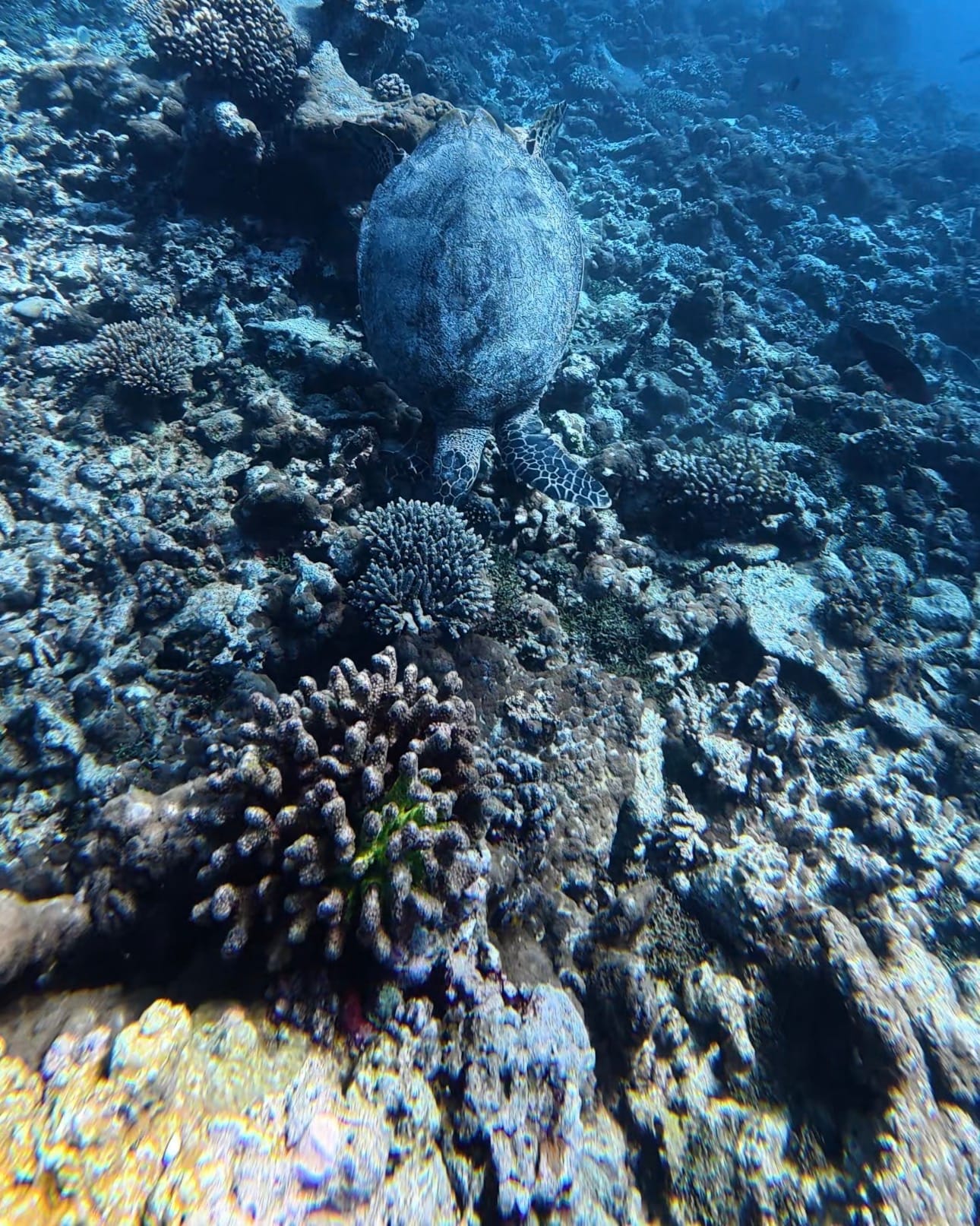
And the water here is worth travelling for. The house reef encircles the island, home to more than a hundred fish species. The PADI dive centre provides access to over fifty sites across the atoll, and the North Ari Atoll is one of the most reliable regions in the Maldives for whale shark encounters throughout the year. But some of the finest moments were the simplest: stepping off my private beach with a mask and finding the reef right there, a few metres from shore, alive and unhurried.
There is an Italian expression, alla buona, that describes a way of doing things that is warm, unpretentious, and generous — the host who sets the table without fuss and then serves you the best meal of the week. Nika operates in this register. It is a family hotel in the deepest sense: owned by the same family for more than forty years, staffed by people who have worked there for decades, shaped by a philosophy that values continuity over novelty. And yet the quality — of food, of cleanliness, of care — places it in a category that many newer, more expensive properties do not reach.
On the island, carpenters are building a traditional eight-metre Maldivian boat by hand. It is slow, deliberate work. The owner describes it as another form of longevity — keeping alive a craft so that it does not disappear. It is also, I think, a metaphor for what Nika itself is doing. In a country where tourism now moves at the speed of architectural render and private equity, this small island in the North Ari Atoll is making the case, quietly and without apology, that the most valuable things are those that were never designed to impress. Only to endure. Perhaps the finest hotels are those that were never meant to be hotels at all?