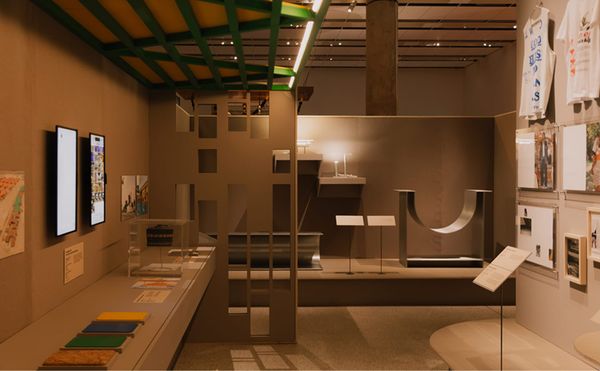
The Nue Black Aesthetic at the Design Museum is open until 8 August 2027. Across six sections, more than 100 objects by 16 contemporary Black designers move between furniture, architecture, fashion, product design and sculpture. The scale matters because it gives guest curator Charlene Prempeh and project curator Tiya Dahyabhai enough room to make a precise argument: Black design is not a single visual language.
For a visitor, the most rewarding approach is therefore selective. Rather than trying to absorb every name and object, follow how personal history becomes material, how familiar forms are revised and how design can create a community around an object. Three contrasts — tailoring and furniture, intimate materials and public symbols, inherited forms and new commissions — bring the exhibition’s proposition into focus.
Why the exhibition refuses one Black aesthetic
The title looks back to the Black Aesthetic movement of the 1960s and the New Black Aesthetic of the 1980s. Here, “Nue” signals nuance. The museum describes designers from diasporic communities whose work may hold shared experiences while remaining grounded in particular heritages, places and practices. Plurality is the curatorial method, not a soft promise of variety.
That distinction protects the show from becoming a catalogue of visual motifs. In British Vogue’s interview with Charlene Prempeh, the curator explains her resistance to treating wax print, colour or a familiar set of motifs as shorthand for African or Caribbean identity. The exhibition is organised instead around identity, community and challenges to established systems, alongside historical context, film and a final commission. The museum identifies Tiya Dahyabhai as project curator; together, their framework asks visitors to notice the choices behind each practice rather than search for a family resemblance.
Scale and structure make the argument visible
More than 100 objects, 16 featured designers and six sections could easily produce a roll-call. The structure gives those numbers a purpose. An opening history establishes that this generation did not appear without precedent. Later sections consider identity as inspiration, community building and the redesign of systems that determine value and inclusion. A film introduces the designers through interviews and studio visits, while the final commission leaves the central question open rather than supplying a neat definition.
The figures are confined to this exhibition, but they create a useful evidence unit for the visitor. Six sections allow a suit, a chair, a football shirt and an installation to be read as different responses to culture and belonging. Sixteen practices also make disagreement possible. A survey about plurality needs enough voices for contrast; otherwise, the thesis would remain a curatorial assertion.
Begin with clothing as a way of reading the body. Bianca Saunders’ suit for Usher at the 2023 Met Gala plays with the conventions of masculine tailoring. Foday Dumbuya’s LABRUM Arsenal away kit from the 2024/25 season works on a more public register: Pan-African colour turns a football shirt into a sign of diasporic belonging. These are both garments, yet one intervenes in formal dress and the other in collective fandom.
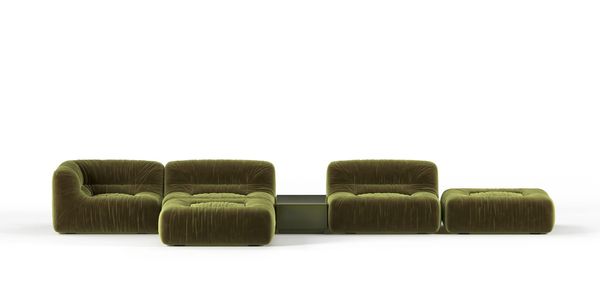
Then look for materials that carry social memory. Taiba Akhuetie’s furniture made from synthetic hair transforms a material associated with the scrutiny and care of textured hair into structure. The shift from something worn or handled to something that supports the body changes its scale without stripping away its cultural charge.
A third stop is Giles Tettey Nartey’s Strange Notes, described in Wallpaper’s detailed exhibition preview as a contemporary response to the West African balafon. It belongs to a section about rethinking systems and challenges the habit of placing traditional African forms safely in the past. The closing commission by Ini Archibong moves differently again: Mfon, a hand-blown Murano-glass chandelier accompanied by an ambient soundtrack, holds several localities and techniques in the same work without pretending they collapse into one identity.
What independent coverage adds
Independent accounts sharpen the difference between breadth and generalisation. Art Fund’s exhibition listing corroborates the 6 November 2026 to 8 August 2027 run and the movement between furniture, fashion, architecture and installation. British Vogue adds the curator’s historical and institutional reasoning, while Wallpaper maps the sequence of sections and individual objects. Together, they support a reading of the show as an intergenerational and diasporic conversation rather than a single stylistic survey.
They also suggest why the exhibition rewards comparison. The key question is not which object best represents Black design. It is what becomes visible when different designers are allowed to define their own relationship to history, community, materials and the design canon.
Planning a visit
As checked on 16 November 2026, the museum lists admission from £15.29 for adults, £11.47 for students and concessions, and £7.65 for children; members enter free. The live Design Museum exhibition page also lists current museum hours of 10am–5pm Monday to Thursday and 10am–6pm Friday to Sunday. These are dynamic starting prices, access terms and hours, so check again before booking.
The museum’s current access information says all exhibitions are wheelchair accessible, paid exhibitions offer a concessionary rate for disabled visitors and accompanying carers enter free. Wheelchairs and Blue Badge parking can be reserved, subject to availability. The exhibition page also lists relaxed openings on 10 and 14 March 2027, with limited tickets, tactile materials and sensory maps. Those arrangements are dynamic; confirm the relevant session and booking requirements before travelling.
The Nue Black Aesthetic is most useful as a set of encounters rather than a proposed definition. Choose a few objects across disciplines, follow the histories inside their materials, then let the differences remain visible. That is not a gap in the exhibition’s argument. It is the argument.